
By DeshiCoast | Craftsmanship | 5 min read
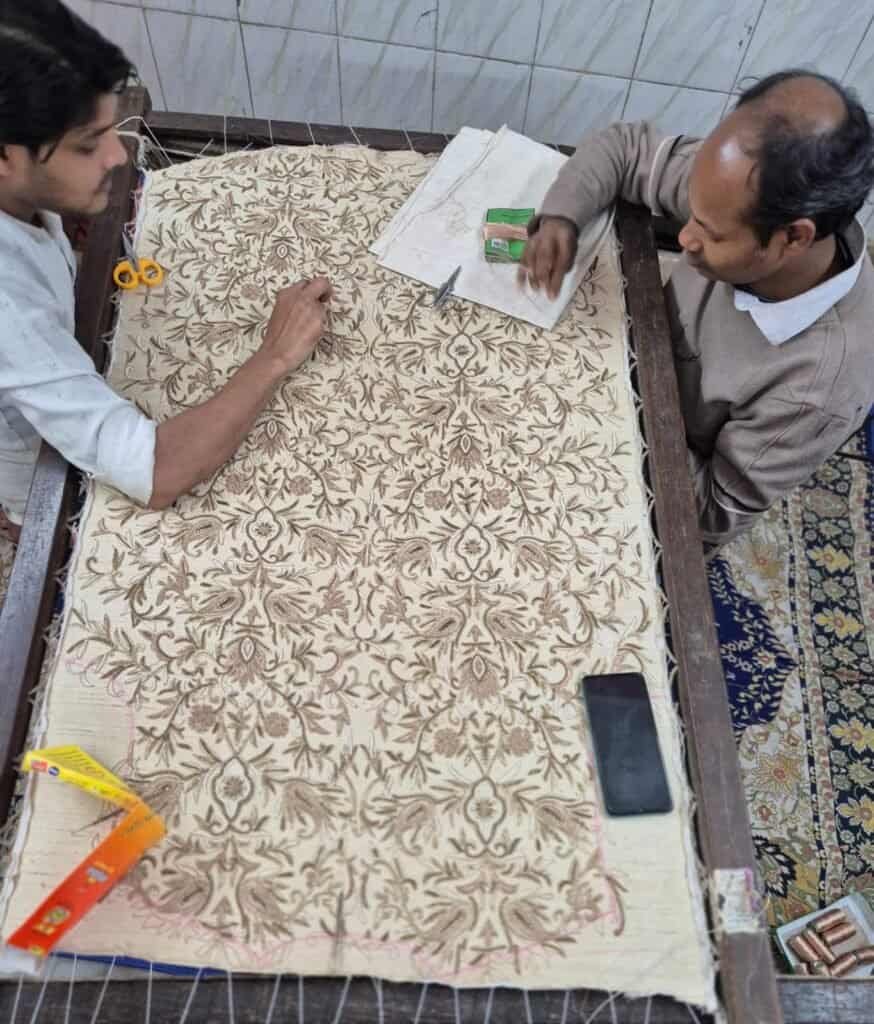
Every hand embroidered sherwani at DeshiCoast begins not in a factory, but at a wooden adda — a traditional frame where master craftsmen bring intricate designs to life, stitch by stitch, thread by thread.
There is a moment before a groom steps out to meet his bride when he runs his fingers over his sherwani and feels every flower, every vine, every delicate motif. What he may not realise is that two artisans spent weeks creating exactly that feeling — needle in hand, bent over a wooden frame, working with total devotion.
This is the story of that work. This is the story of our craftsmen.
This is the story of that work. This is the story of our craftsmen.
Two Hands, One Frame — The Soul of Every DeshiCoast Sherwani
At DeshiCoast, every hand embroidered sherwani starts at a wooden adda — a traditional embroidery frame. First, the artisan stretches fine cream or ivory fabric across it. Then, he pins a paper pattern beside it, tracing the design that will guide every stitch.
Two craftsmen sit face to face at the frame. One holds the needle. The other watches the pattern. Together, they bring it to life with extraordinary care and patience.
The work moves slowly by design. A single sherwani panel takes anywhere from 10 to 30 days, depending on the complexity. Furthermore, every motif — the paisley, the lotus, the trailing vines — receives deliberate attention. There is no rushing this process, and there are no shortcuts worth taking.
This craft is zardozi and resham hand embroidery, a tradition passed down through generations across India’s finest textile regions. Therefore, when you wear a DeshiCoast sherwani, you carry that legacy with you.
Why Every Hand Embroidered Sherwani Looks Different from Machine Work
Today, most fashion brands use machine embroidery because it is faster and cheaper. However, the difference becomes clear the moment you wear something handmade.
First, hand embroidery has depth. Artisans lay each stitch at a slightly different angle, so the fabric catches light in a unique way. As a result, the embroidery shimmers and feels three-dimensional — something no machine can replicate.
Second, hand embroidery gives your outfit character. Because human hands create each piece, no two sherwanis are ever identical. Consequently, your outfit is genuinely one of a kind.
Third, and most importantly, hand embroidery carries soul. When you wear something made with this level of care, it shows in how you carry yourself. Customers feel this difference immediately.
At DeshiCoast, we made a deliberate choice to protect this craft — not because it is easy, but because the men who wear our garments deserve nothing less.
The Master Craftsmen Behind Your Outfit
The artisans who create our embroidery are not factory workers. Instead, they are specialists — often second or third generation embroiderers who learned from their fathers and grandfathers.
Over decades, they developed knowledge that cannot be automated. For example, they know which threads hold their colour after years of wear. In addition, they understand how to space a floral repeat so it looks balanced across the full length of a kurta. Moreover, they know when to increase stitch density on the chest piece to make it the visual centrepiece of the outfit.
When you invest in a DeshiCoast sherwani, you therefore support a living craft tradition that has survived for centuries and deserves to survive for centuries more.
What to Look for in a Hand Embroidered Sherwani
If you want to verify that embroidery is genuinely handmade, here is what to check:
Check the back of the fabric. Hand embroidery shows visible thread movement on the reverse side. In contrast, machine embroidery looks identical on both sides.
Run your fingers over the motifs. Handwork feels rich and textured due to subtle irregularities. Machine embroidery, on the other hand, feels flat and uniform.
Examine the edges of the design. Hand-embroidered borders taper naturally. Meanwhile, machine patterns repeat with perfect uniformity and no variation.
Ask the brand directly. At DeshiCoast, we always share the craft story behind every piece.
The Best Occasions to Wear a Hand Embroidered Sherwani
Hand embroidered sherwanis suit the most important moments in a man’s life. Here are the occasions where they truly shine:
Wedding day — your sherwani should match the gravity and joy of the occasion
Reception — a lighter bandhgala or kurta set with fine embroidery strikes the perfect balance
Engagement ceremony — where you want to look polished yet relaxed
Festive occasions — Eid, Diwali, and family celebrations where ethnic wear feels most at home
If you are dressing for one of these moments, it is worth choosing something made by hand.
A Final Word
The photograph at the top of this post was taken at the workshop where our garments are made. It shows two craftsmen at work on a Sherwani panel — a cream fabric covered in an intricate floral repeat, traced in warm brown thread.
It is an ordinary afternoon for them. For the man who will eventually wear that Sherwani on his wedding day, it will be anything but ordinary.
That is exactly why we do this.
Explore our hand embroidered sherwani collection at DeshiCoast
Free shipping across India. Custom sizing available. Learn more about zardozi embroidery — one of India’s most treasured textile traditions